
Stock Your Holiday Pantry Now: What to Buy in October to Save Money Later
The holidays have a funny way of sneaking up on the grocery budget
October doesn’t exactly scream holiday grocery shopping.
We’re still thinking about cooler weather, Halloween candy and maybe whether it’s finally time to turn the heat on. Thanksgiving feels a little ways off, and Christmas dinner certainly doesn’t seem urgent yet.
But this is actually one of my favorite times to start thinking about the food side of the holidays.
Not because I want you filling a cart with six weeks’ worth of groceries. And we’re definitely not turning the spare bedroom into a canned-goods warehouse.
We’re simply going to use October to take a little pressure off November and December.
When you stock your holiday pantry thoughtfully, you can spread some of those extra grocery costs across several shopping trips, watch for good prices on things you know you’ll use and avoid that awful holiday checkout moment when the total on the screen makes you wonder whether you accidentally bought the shopping cart too.
The trick is knowing what makes sense to buy now, what deserves a spot on your watch list and what should stay at the store until closer to the holiday.
BUY • WATCH • WAIT
- BUY shelf-stable or freezer-friendly foods you know you’ll use when the price makes sense.
- WATCH items you need but can wait to buy when a better sale comes along.
- WAIT on fresh and highly perishable foods until closer to the holiday.
Disclosure: This post may contain affiliate links, which means I may receive a small commission if you make a purchase through my links — at no extra cost to you. I only recommend tools and products I personally use and trust.
Table of Contents
Start With the Holiday You Actually Plan to Have
Before we talk about canned pumpkin or chicken broth, let’s talk about your holiday.
Who’s coming? What are you cooking? Are you hosting Thanksgiving, Christmas or both? Will family stay overnight? Do you bake every year, or do you happily let the bakery handle dessert?
There’s no point stocking up for somebody else’s holiday.
If Thanksgiving is the bigger food holiday at your house, a little planning can make a big difference. My Thanksgiving on a Budget guide has more ways to keep the meal festive without letting the grocery bill get away from you.
If your Thanksgiving is six people and Christmas dinner is at your daughter’s house, your pantry shouldn’t look like you’re feeding the Dallas Cowboys.
Think through the meals you really expect to make. You don’t need a detailed menu yet. A rough list is enough.
Maybe Thanksgiving means turkey, dressing, green beans, mashed potatoes and pie. Christmas might mean ham, a couple of sides and breakfast for overnight guests.
Now you have something useful to shop for.
Tip:
Make a small USE FIRST area in your pantry or freezer for foods that should be eaten sooner. Food you’ve already paid for is the cheapest food in the house.
Before You Buy Anything, Shop Your Own Kitchen
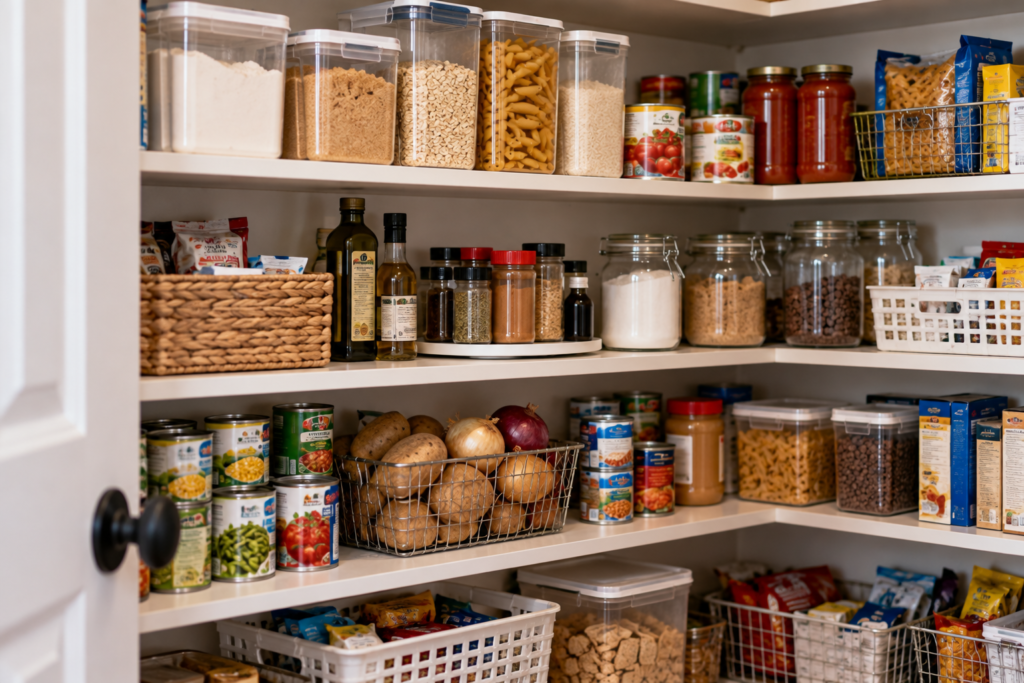
This part isn’t exciting, but it can save you from buying your fourth container of cinnamon.
Take ten minutes and look through the pantry, freezer and refrigerator. Pull things forward. Check dates. See what’s hiding behind the cereal.
You may already have broth, canned vegetables, baking chocolate, flour, sugar, crackers, pasta or other ingredients that will show up in your holiday meals.
If your pantry tends to hide things behind other things, a few clear pantry bins or over-door-organizers can make it much easier to see what you already have before you buy more.
I also like having a little USE FIRST area for foods that need to be eaten sooner. Nothing fancy. It can be one pantry shelf, one basket or one section of the cabinet.
If you’ve got two cans of green beans that should be used before the newer ones, put them where you’ll see them. If there’s a bag of pecans in the freezer from last Christmas, now would be an excellent time to find out whether they’re still something you want to use.
Food we already paid for is the cheapest food in the house.
Come Hang Out With Me on YouTube!

Every week I share easy-to-follow videos created especially for adults 55+.
You’ll find:
💰 Money-saving tips
📱 Simple technology tutorials
🛒 Smart shopping strategies
❤️ Real-life solutions for everyday living
🎬 Click below and subscribe!
👉 youtube.com/@boomersonabudget
Make a Simple Holiday Shopping List
Once you’ve looked through what you already have, jot down the ingredients and supplies you’re likely to need for the meals you’re actually planning.
This doesn’t have to be a giant master list or a complicated system. The goal is simply to get the holiday extras out of your head and onto paper so you can notice good prices as you shop over the next several weeks.
Keep it handy when you check weekly ads or make your regular grocery list. If something you know you’ll need is at a price you’re comfortable with and it will keep safely until the holiday, you can pick it up. If not, leave it for another trip.
Planning ahead gives you time to be selective instead of making one expensive last-minute grocery run.
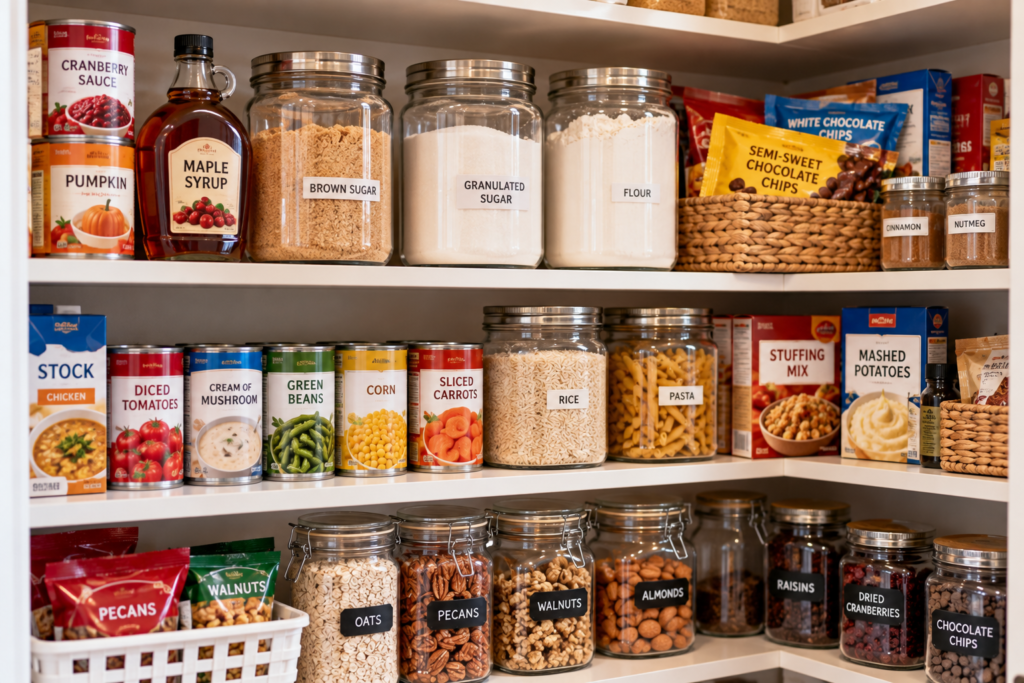
What to Buy When You Stock Your Holiday Pantry
The best early buys aren’t necessarily the foods with the biggest SALE sign.
They’re foods that meet three tests: you know you’re going to use them, they’ll keep safely until you need them, and the price is good enough that you’re comfortable buying them now.
Depending on your holiday menu, that could include broth or stock, canned pumpkin, canned vegetables, cranberry sauce, stuffing mix, flour, sugar, chocolate chips, pasta, rice, crackers, coffee, tea and shelf-stable sauces or condiments.
Don’t forget the non-food things you know you’ll need either. Foil, parchment paper, food-storage bags and containers have a way of disappearing right when the leftovers need somewhere to go.
If you have freezer room, some foods can also be bought ahead when the price makes sense. Butter is one example for households that use a lot of it during holiday baking.
But please don’t treat that as a universal “buy this now” list.
If nobody at your house eats cranberry sauce, three cans for the price of two means you paid for three cans nobody wants.
That’s not saving money. That’s pantry decor.
Tip:
PURPOSE DOESN’T NEED A JOB TITLE
You don’t need a title, paycheck or packed calendar to matter. Sometimes purpose looks surprisingly ordinary: one person, one commitment and knowing your presence makes a difference.
Early Doesn’t Automatically Mean Cheaper
October gives us more time. It doesn’t guarantee us the lowest price.
Some traditional holiday foods may be promoted more heavily as Thanksgiving gets closer. So unless you already know you’re looking at a good price, there’s nothing wrong with putting an item on the WATCH list instead of buying it today.
You don’t need a complicated price book. For the holiday staples you buy every year, just start noticing what they cost.
Snap a picture of the shelf tag. Save the price in your phone. Glance at the weekly ad.
After a while, you get a pretty good feel for whether $2.49 is a bargain or whether that same item regularly drops to $1.49.
A red SALE sign is advertising. Knowing what you normally pay is information.
I’ll take information.
Sign-up for the Boomer Buzz Newsletter for weekly savings tips for everyday spending, meal plnning, easy side hustles and more.
The Real Win May Be Spreading Out the Cost
Sometimes saving money isn’t about paying dramatically less for every item. Sometimes it’s about keeping one month from getting walloped.
Let’s say you expect Thanksgiving and Christmas groceries to add another $150 to your normal food spending.
Finding an extra $150 during one already-expensive week can hurt. But adding $20 or $25 of planned holiday foods to several regular grocery trips may be much easier to absorb.
If setting aside a little money each week would help, the Envelope Budgeting System is a simple way to give holiday groceries their own spending limit instead of letting them disappear into the regular grocery budget.
You’re still watching the total. You’re still sticking to the foods on your plan.
You’re simply giving the expense somewhere to go besides one giant November or December grocery bill.
That matters when you’re living on Social Security, a fixed income or simply trying to keep your monthly spending predictable.
Saving money isn’t always about paying less. Sometimes it’s about planning ahead so one expensive month doesn’t knock everything else sideways.

Be Careful With the “Stock Up!” Trap
I love a good stock-up price.
I do not love buying six of something because the sign convinced me six was a personality requirement.
Before putting multiples in the cart, ask yourself whether you’ll really use them. Do you normally buy this food? Is it actually part of your holiday plan? Will you use the extras after Christmas? Do you have room to store them properly? And, my favorite question, is the price actually good?
If the answer is no, keep walking.
A bargain that expires in the back of the pantry isn’t a bargain. Neither is a family-size package that costs more per ounce than the smaller one.
This is one of those places where taking fifteen seconds to look at the unit price can save you from being fooled by the size of the package.
Your Freezer Is Part of the Holiday Pantry Too
Before you start adding holiday food to the freezer, take a peek inside.
If yours is anything like a normal freezer, there may be a few things in there that have lost their identity.
Is that chili? Spaghetti sauce? A science experiment?
And if you’re staring at something in the pantry or freezer wondering, “How long have I had THAT?” the FoodKeeper resource can help you check recommended storage times for hundreds of foods.
October is a good time to use up older food, toss anything that shouldn’t still be there and make a little room.
Not sure how long something can safely stay in the refrigerator or freezer? The FDA’s food storage guidance is a handy reference for checking safe storage temperatures and food-handling recommendations.
Then you can use that space strategically. Maybe you find a good price on butter. Maybe a meat you know you’ll serve is on sale. Maybe you make a casserole or baked item ahead because that’s one less thing you’ll have to do during a busy week.
Label it. Date it.
Future You deserves better than staring at a frozen container on December 23 and trying to remember what on earth is in it.
Stay Flexible Where It Doesn’t Matter
Every family has those holiday foods where somebody will absolutely notice if you change brands.
Fine. This is not the year to start a cranberry-sauce uprising at Thanksgiving dinner.
But there are probably plenty of ingredients where the brand doesn’t matter much at all.
Compare the store brand. Look at the unit price. Use a digital coupon if it’s for something already on your list.
If one brand of broth is considerably cheaper and nobody at the table could tell the difference if their life depended on it, that’s an easy place to save.
Spend where the difference matters to you. Save where it doesn’t.

Don’t Forget the Little Stuff
The main meal gets all the attention, but the grocery budget can get nickeled and dimed by everything surrounding it.
Breakfast for overnight guests. Snacks. Coffee. Beverages. Whipped topping. Appetizers. Candy dishes. Foil pans. Storage containers.
That one ingredient for the recipe you saw online at 10:30 at night and suddenly decided your family could not possibly celebrate Christmas without.
Put those extras on your holiday food list too.
If you know they’re coming, they’re much less likely to become surprise spending.
Some Things Really Should Wait
Planning ahead does not mean buying lettuce in October for Thanksgiving.
Fresh produce, short-dated dairy, bakery items and other highly perishable foods usually belong on the WAIT list.
Buying something early only saves money if it’s still good when you’re ready to eat it.
And don’t fill every inch of your refrigerator or freezer too soon. You’ll need room later.
The goal is to make the holiday easier, not spend Thanksgiving trying to fit a pie into the refrigerator like you’re playing Tetris.
Leave Yourself Room to Change Your Mind
Holiday plans change because families change their minds.
Someone can’t come. Someone else brings a guest. Your daughter says, “Don’t make dessert. I’m bringing it.”
You see the price of one ingredient and decide that side dish isn’t nearly as important as you thought it was.
That’s okay.
A stocked holiday pantry should give you options, not lock you into a menu.
Buy the versatile foods you know you’ll use. Be more cautious with specialty ingredients that only work for one recipe.
And don’t buy so far ahead that you’re cooking something nobody wants simply because you already paid for it.

YOUR OCTOBER HOLIDAY PANTRY PLAN
Shop your kitchen first. Keep a BUY, WATCH and WAIT list. Pick up planned shelf-stable foods when the price is right. Spread purchases over several grocery trips. Leave the fresh stuff for later.
A Little October Planning Can Make December Feel Better
You don’t need to buy the holidays in October.
You just need to make November and December do a little less heavy lifting.
Start with the meals you actually expect to make. Shop your own pantry. Keep a BUY, WATCH and WAIT list. Pick up the shelf-stable and freezer-friendly foods you know you’ll use when the price makes sense. Spread some of the extra cost across several grocery trips. And leave the fresh stuff for later.
None of this is glamorous.
But when December rolls around and half the things you need are already sitting in the pantry, paid for and ready to go?
That’s a pretty nice little gift you gave yourself back in October
Watch those dollars y’all,

Come Join The Thrifty Boomers Facebook Group